
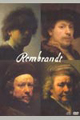

Rembrandt van Rijn
Selected
Works: 1655-1669
Many writers, in attempting to describe the nature of Rembrandt's genius, have compared him to Shakespeare. Roger Fry in The Arts of Painting and Sculpture says that Rembrandt has a unique place in the history of European art because 'he united in his spirit a dramatic and psychological imagination of Shakespearian intensity and an equally great plastic imagination'. It would be contrived and unhelpful to press of the comparison too for; indeed there were radical differences between the philosophies of the two men as G. Knuttel Wzn. points out. Yet Knuttel goes on to say that 'No artist before Rembrandt has researched and understood the human soul and so movingly and convincingly attested to it as Shakespeare'.
Writers tend to reach for Shakespeare's name when describing Rembrandt for several reasons. First, of course, a Titan, in art as in other spheres, can only be compared with another-and there are few of these to choose from. Secondly, and more constructively, the two artists are comparable in the breadth of their understanding and their sympathy for the human condition. Thirdly, and growing out of the last point, they share the quality of universality.
Rembrandt, like Shakespeare uses his art to convey ideas which apply to human beings of all times and all cultures. Great art is, in this sense, timeless. Élie Faure, the French art critic and historian, wrote this of Rembrandt and his work: 'His humanity is truly formidable, it is fatal like lament, love; change continues, indifferent and dramatic, between all that is born and all that dies. He follows our steps to death in the traces of blood which mark them. He does not pity us, he does not comfort us, because he is with us, because he is us.' *
click here for the complete online catalogue of Rembrandt's painting
  |
Hendrickje Stoffels (?) c. 1654-1660 |
  |
A Woman Sleeping c. 1655 |
 |
An Old Woman
Reading 1655 |
 |
Joseph and
Potiphar's Wife 1655 |
 |
A Man in Armour 1655 |
 |
The Polish Rider 1655 |
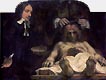 |
The Anatomy Lesson of Dr Joan Deyman 1656 |
 |
Jacob Blessing the
Children of Joseph 1656 |
 |
Hendrickje Stoffels (?) 1654-59 |
 |
A Woman at
an Open Door c. 1656-1657 |
 |
Carcass of Beef 1657 |
 |
Catrina Hooghsaet 1657 |
 |
Moses 1659 |
 |
A Young Monk (Titus) 1660 |
 |
Matthew
and the Angel 1661 |
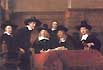 |
The Syndics (The Sampling Officials of
the Amsterdam Draper's Guild) 1663 |
 |
Juno c. 1662-1665 |
 |
Woman with a Pink early 1660s |
 |
Portrait of
Frederick Rihel on Horseback 1663 |
 |
Man Wearing a Beret 1663 73 x 60 cm. Dulwich College, London |
 |
Winter-Landscape 1664 |
 |
Lucretia 1664 |
 |
Bathsheba 1664 |
 |
The Jewish Bride c. 1665 |
 |
Portrait of a Boy c.1665-1666 |
 |
Return of the
Prodigal Son c. 1666 |
 |
Portrait
of a Man 1667 |
 |
Portrait of an
Eldery Man 1667 |
 |
Simon with Jesus 1669 |